Kralan (Cambodian Bamboo Sticky Rice)
When walking on the streets of Cambodia in the early morning, you can smell the sweet aroma of ripe rice emanating from the stalls selling Kralan.
Kralan is a popular dish in Cambodia made from glutinous rice and black-eyed peas or beans soaked in coconut milk before being stuffed in bamboo tubes.
Traditionally, Kralan is slowly cooked over embers or firewood; a successful part of Kralan will have evenly cooked rice, fragrant and fragrant without the bamboo bark being burned.
When you eat this Kralan dish, you will feel the sweetness of glutinous rice, the flesh of red beans, and the richness of coconut milk. If you are curious about its taste, you can find this attractive dish at street vendors or shops in the market or on the street.
Places To Try The Food: Look for the women’s food stalls or the ladies on bicycles selling Kralan near Angkor Wat, Siem Reap.
To make his goat stew, Uncle Goat, as he's called, created an oven cave where he cooks it for three days and three nights.
Magistrate Liu's is one of the oldest stalls in Chiayi, where Liu-Zhu has been serving turkey rice and chicken rice for 50 years.
Tsui-Eh's douhua (aka rice pudding, "the dessert of Taiwan") is the best in Chiayi, according to Street Food—she's been making it the same way for over sixty years.
Chiayi Night Market, Chiayi, Taiwan
A common and easy to eat street food is Guay Teow or Noodle Soup. The main ingredient, of course, is noodles but with more varied additions. Rice or egg noodles served in a thick, flavorful broth with meat, dumplings or vegetables.
The standard components provided are chili, lime juice, sugar, and fish sauce. Sangkin delicious, don't forget to chew it first when you try this dish.
Guay Teow is one of the most customizable Thai dishes. You can choose everything from the type and width of the noodles to the seasoning.
Franklin Pierce was the 14th President of the United States, a northern Democrat who saw the abolitionist movement as a fundamental threat to the unity of the nation.
Born: November 23, 1804, Hillsborough, New Hampshire, United States Died: October 8, 1869, The Pierce Manse, Concord, New Hampshire, United States Party: Democratic Party Presidential term: March 4, 1853 – March 4, 1857 Profession: Lawyer Vice president: William R. King (1853)
Franklin Pierce became 14th President of the United States at a time of apparent tranquility (1853-1857). By pursuing the recommendations of southern advisers, Pierce — a New Englander — hoped to ease the divisions that led eventually to Civil War.
Franklin Pierce became President at a time of apparent tranquility. The United States, by virtue of the Compromise of 1850, seemed to have weathered its sectional storm. By pursuing the recommendations of southern advisers, Pierce–a New Englander–hoped to prevent still another outbreak of that storm. But his policies, far from preserving calm, hastened the disruption of the Union.
Born in Hillsborough, New Hampshire, in 1804, Pierce attended Bowdoin College. After graduation he studied law, then entered politics. At 24 he was elected to the New Hampshire legislature; two years later he became its Speaker. During the 1830’s he went to Washington, first as a Representative, then as a Senator.
Pierce, after serving in the Mexican War, was proposed by New Hampshire friends for the Presidential nomination in 1852. At the Democratic Convention, the delegates agreed easily enough upon a platform pledging undeviating support of the Compromise of 1850 and hostility to any efforts to agitate the slavery question. But they balloted 48 times and eliminated all the well-known candidates before nominating Pierce, a true “dark horse.”
Probably because the Democrats stood more firmly for the Compromise than the Whigs, and because Whig candidate Gen. Winfield Scott was suspect in the South, Pierce won with a narrow margin of popular votes.
Two months before he took office, he and his wife saw their eleven-year-old son killed when their train was wrecked. Grief-stricken, Pierce entered the Presidency nervously exhausted.
In his Inaugural he proclaimed an era of peace and prosperity at home, and vigor in relations with other nations. The United States might have to acquire additional possessions for the sake of its own security, he pointed out, and would not be deterred by “any timid forebodings of evil.”
Pierce had only to make gestures toward expansion to excite the wrath of northerners, who accused him of acting as a cat’s-paw of Southerners eager to extend slavery into other areas. Therefore he aroused apprehension when he pressured Great Britain to relinquish its special interests along part of the Central American coast, and even more when he tried to persuade Spain to sell Cuba.
But the most violent renewal of the storm stemmed from the Kansas-Nebraska Act, which repealed the Missouri Compromise and reopened the question of slavery in the West. This measure, the handiwork of Senator Stephen A. Douglas, grew in part out of his desire to promote a railroad from Chicago to California through Nebraska. Already Secretary of War Jefferson Davis, advocate of a southern transcontinental route, had persuaded Pierce to send James Gadsden to Mexico to buy land for a southern railroad. He purchased the area now comprising southern Arizona and part of southern New Mexico for $10,000,000.
Douglas’s proposal, to organize western territories through which a railroad might run, caused extreme trouble. Douglas provided in his bills that the residents of the new territories could decide the slavery question for themselves. The result was a rush into Kansas, as southerners and northerners vied for control of the territory. Shooting broke out, and “bleeding Kansas” became a prelude to the Civil War.
By the end of his administration, Pierce could claim “a peaceful condition of things in Kansas.” But, to his disappointment, the Democrats refused to renominate him, turning to the less controversial Buchanan. Pierce returned to New Hampshire, leaving his successor to face the rising fury of the sectional whirlwind. He died in 1869.
Millard Fillmore was born January 7, 1800 in a log cabin, on a farm in what is now Moravia, Cayuga County, in the Finger Lakes region of New York. His parents were Phoebe (Millard) and Nathaniel Fillmore—he was the second of eight children and the oldest son. Nathaniel Fillmore was the son of Nathaniel Fillmore Sr. (1739–1814), a native of Franklin, Connecticut who became one of the earliest settlers of Bennington when it was founded in the territory then called the New Hampshire Grants.
Nathaniel Fillmore and Phoebe Millard moved from Vermont in 1799, seeking better opportunities than were available on Nathaniel's stony farm, but the title to their Cayuga County land proved defective, and the Fillmore family moved to nearby Sempronius, where they leased land as tenant farmers, and Nathaniel occasionally taught school. Historian Tyler Anbinder described Fillmore's childhood as, "...one of hard work, frequent privation, and virtually no formal schooling".
Over time, Nathaniel became more successful in Sempronius, though during Millard’s formative years the family endured severe poverty. Nathaniel became sufficiently regarded that he was chosen to serve in local offices including justice of the peace. In hopes his oldest son would learn a trade, he convinced Millard at age 14 not to enlist for the War of 181 and apprenticed him to cloth maker Benjamin Hungerford in Sparta. Fillmore was relegated to menial labor; unhappy at not learning any skills, he left Hungerford's employ. His father then placed him in the same trade at a mill in New Hope. Seeking to better himself, Millard bought a share in a circulating library, and read all the books he could. In 1819, he took advantage of idle time at the mill to enroll at a new academy in the town, where he met a classmate, Abigail Powers, and fell in love with her.
Later in 1819, Nathaniel moved the family to Montville, a hamlet of Moravia. Appreciating his son's talents, Nathaniel followed his wife's advice and persuaded Judge Walter Wood, the Fillmores' landlord and the wealthiest person in the area, to allow Millard to be his law clerk for a trial period. Wood agreed to employ young Fillmore, and to supervise him as he read law. Fillmore earned money teaching school for three months and bought out his mill apprenticeship. He left Wood after 18 months—the judge paid him almost nothing, and the two quarreled after Fillmore, unaided, earned a small sum advising a farmer in a minor lawsuit. Refusing to pledge not to do it again, Fillmore gave up his clerkship. Nathaniel again moved the family, and Millard accompanied them west to East Aurora, in Erie County, near Buffalo., where Nathaniel purchased a farm which became prosperous.
In 1821, Fillmore turned 21 and reached emancipation. He taught school in East Aurora, and accepted a few cases in justice of the peace courts, which did not require the practitioner to be a licensed attorney. He moved to Buffalo the following year and continued his study of law—first while teaching school, and then in the law office of Asa Rice and Joseph Clary. At that time he also became engaged to Abigail Powers. In 1823, he was admitted to the New York bar, declined offers from Buffalo law firms, and returned to East Aurora to establish a practice as the town's only residing lawyer. Later in life, Fillmore stated that he initially lacked the self-confidence to practice in the larger city of Buffalo; his biographer, Paul Finkelman, suggested that after being under others' thumbs all his life, Fillmore enjoyed the independence of his East Aurora practice. On February 5, 1826, Millard and Abigail wed, and later had two children, Millard Powers Fillmore (1828–1889) and Mary Abigail Fillmore (1832–1854)
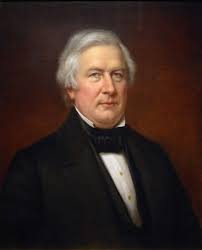
Millard Fillmore was the 13th President of the United States, the last to be a member of the Whig Party while in the White House. A former U.S. Representative from New York, Fillmore was elected the nation's 12th Vice President in 1848, and was elevated to the presidency by the death of Zachary Taylor.
Born: January 7, 1800, New York, United States Died: March 8, 1874, Buffalo, New York, United States Presidential term: July 9, 1850 – March 4, 1853 Profession: Lawyer Spouse: Caroline C. Fillmore (m. 1858–1874), Abigail Fillmore (m. 1826–1853) Children: Millard Powers Fillmore, Mary Abigail Fillmore
Millard Fillmore (January 7, 1800 – March 8, 1874) was the 13th president of the United States (1850–1853), the last to be a member of the Whig Party while in the White House. A former U.S. Representative from New York, Fillmore was elected the nation's 12th vice president in 1848, and was elevated to the presidency by the death of Zachary Taylor. He was instrumental in getting the Compromise of 1850 passed, a bargain that led to a brief truce in the battle over slavery. He failed to win the Whig nomination for president in 1852; he gained the endorsement of the nativist Know Nothing Party four years later, and finished third in that election.
Fillmore was born into poverty in the Finger Lakes area of New York state—his parents were tenant farmers during his formative years. Though he had little formal schooling, he rose from poverty through diligent study and became a successful attorney. He became prominent in the Buffalo area as an attorney and politician, was elected to the New York Assembly in 1828, and to the U.S. House of Representatives in 1832. Initially, he belonged to the Anti-Masonic Party, but became a Whig as the party formed in the mid-1830s; he was a rival for state party leadership with editor Thurlow Weed and Weed's protégé, William H. Seward. Through his career, Fillmore declared slavery an evil, but one beyond the powers of the federal government, whereas Seward was not only openly hostile to slavery, he argued that the federal government had a role to play in ending it. Fillmore was an unsuccessful candidate for Speaker of the House when the Whigs took control of the chamber in 1841, but was made Ways and Means Committee chairman. Defeated in bids for the Whig nomination for vice president in 1844, and for New York governor the same year, Fillmore was elected Comptroller of New York in 1847, the first to hold that post by direct election.
Fillmore received the Whig vice presidential nomination in 1848 as Taylor's running mate, and the two were elected. He was largely ignored by Taylor, even in the dispensing of patronage in New York, on which Taylor consulted Weed and Seward. As vice president, Fillmore presided over angry debates in the Senate as Congress decided whether to allow slavery in the Mexican Cession. Fillmore supported Henry Clay's Omnibus Bill (the basis of the 1850 Compromise) though Taylor did not. After President Taylor died in July 1850, Fillmore dismissed the cabinet and changed the administration's policy. The new president exerted pressure to gain the passage of the Compromise, which gave legislative victories to both North and South, and which was enacted by September. The Fugitive Slave Act, expediting the return of escaped slaves to those who claimed ownership, was a controversial part of the Compromise, and Fillmore felt himself duty-bound to enforce it, though it damaged his popularity and also the Whig Party, which was torn North from South. In foreign policy, Fillmore supported U.S. Navy expeditions to open trade in Japan, opposed French designs on Hawaii, and was embarrassed by Narciso López's filibuster expeditions to Cuba. He sought election to a full term in 1852, but was passed over by the Whigs in favor of Winfield Scott.
As the Whig Party broke up after Fillmore's presidency, many in Fillmore's conservative wing joined the Know Nothings, forming the American Party. In his 1856 candidacy as that party's nominee, Fillmore had little to say about immigration, focusing instead on the preservation of the Union, and won only Maryland. In retirement, Fillmore was active in many civic endeavors—he helped in founding the University of Buffalo and served as its first chancellor. During the American Civil War, Fillmore denounced secession and agreed that the Union must be maintained by force if necessary, but was critical of the war policies of Abraham Lincoln. After peace was restored, he supported the Reconstruction policies of President Andrew Johnson. Though he is relatively obscure today, Fillmore has been praised by some, for his foreign policy, and criticized by others, for his enforcement of the Fugitive Slave Act and his association with the Know Nothings. Historians and scholars have consistently ranked Fillmore as one of the worst presidents.
Zachary Taylor was the 12th President of the United States, serving from March 1849 until his death in July 1850. Taylor previously was a career officer in the United States Army, rose to the rank of major general and became a national hero as a result of his victories in the Mexican–American War.
Born: November 24, 1784, Barboursville, Virginia, United States Died: July 9, 1850, The White House, Washington, D.C., United States Nickname: Old Rough and Ready Presidential term: March 4, 1849 – July 9, 1850 Vice president: Millard Fillmore (1849–1850) Children: Sarah Knox Taylor, Richard Taylor, Mary Elizabeth Bliss, Octavia Pannell, Ann Mackall, Margaret Smith
Zachary Taylor (November 24, 1784 – July 9, 1850) was the 12th president of the United States, serving from March 1849 until his death in July 1850. Taylor previously was a career officer in the United States Army, rose to the rank of major general and became a national hero as a result of his victories in the Mexican–American War. As a result, he won election to the White House despite his vague political beliefs. His top priority as president was preserving the Union, but he died sixteen months into his term, before making any progress on the status of slavery, which had been inflaming tensions in Congress.
Taylor was born into a prominent family of plantation owners who moved westward from Virginia to Kentucky in his youth. He was commissioned as an officer in the U.S. Army in 1808 and made a name for himself as a Captain in the War of 1812. He climbed the ranks establishing military forts along the Mississippi River and entered the Black Hawk War as a Colonel in 1832. His success in the Second Seminole War attracted national attention and earned him the nickname "Old Rough and Ready". In 1845, during the annexation of Texas, President James K. Polk dispatched Taylor to the Rio Grande in anticipation of a battle with Mexico over the disputed Texas–Mexico border. The Mexican–American War broke out in April 1846, and Taylor defeated Mexican troops commanded by General Mariano Arista at the battles of Palo Alto and Resaca de la Palma and drove his troops out of Texas. Taylor then led his troops into Mexico, where they defeated Mexican troops commanded by Pedro de Ampudia at the Battle of Monterrey. Defying orders, Taylor led his troops further south and, despite being severely outnumbered, dealt a crushing blow to Mexican forces under Antonio López de Santa Anna at the Battle of Buena Vista. Taylor's troops were transferred to the command of Major General Winfield Scott, but Taylor retained his popularity.
The Whig Party convinced the reluctant Taylor to lead their ticket in the 1848 presidential election, despite his unclear political tenets and lack of interest in politics. At the 1848 Whig National Convention, Taylor defeated Scott and former Senator Henry Clay to take the nomination. He won the general election alongside New York politician Millard Fillmore, defeating Democratic Party candidates Lewis Cass and William Orlando Butler, as well as a third-party effort led by former president Martin Van Buren and Charles Francis Adams, Sr. of the Free Soil Party. Taylor became the first president to be elected without having served in a prior political office.
As president, Taylor kept his distance from Congress and his cabinet, even though partisan tensions threatened to divide the Union. Debate over the status of slavery in the Mexican Cession dominated the political agenda and led to threats of secession from Southerners. Despite being a Southerner and a slaveholder himself, Taylor did not push for the expansion of slavery, and sought sectional harmony above all other concerns. To avoid the issue of slavery, he urged settlers in New Mexico and California to bypass the territorial stage and draft constitutions for statehood, setting the stage for the Compromise of 1850. Taylor died suddenly of a stomach-related illness in July 1850, with his administration having accomplished little aside from the ratification of the Clayton–Bulwer Treaty. Fillmore served the remainder of his term. Historians and scholars have ranked Taylor in the bottom quartile of U.S. presidents, owing in part to his short term of office (16 months), and he has been described as "more a forgettable president than a failed one."
James Knox Polk was the 11th President of the United States. He previously was Speaker of the House of Representatives and Governor of Tennessee. A protégé of Andrew Jackson, he was a member of the Democratic Party and an advocate of Jacksonian democracy.
Born: November 2, 1795, Pineville, North Carolina, United States Died: June 15, 1849, Nashville, Tennessee, United States Presidential term: March 4, 1845 – March 4, 1849 Party: Democratic Party Vice president: George M. Dallas (1845–1849) Spouse: Sarah Childress Polk (m. 1824–1849)
James Knox Polk (November 2, 1795 – June 15, 1849) was the 11th president of the United States (1845–1849). He previously was speaker of the House of Representatives (1835–1839) and governor of Tennessee (1839–1841). A protégé of Andrew Jackson, he was a member of the Democratic Party and an advocate of Jacksonian democracy. During Polk's presidency, the United States expanded significantly with the annexation of the Republic of Texas, the Oregon Territory, and the Mexican Cession following the American victory in the Mexican–American War.
After building a successful law practice in Tennessee, Polk was elected to the state legislature (1823) and then to the United States House of Representatives in 1825, becoming a strong supporter of Jackson. After serving as chairman of the Ways and Means Committee, he became Speaker in 1835, the only president to have been Speaker. Polk left Congress to run for governor; he won in 1839, but lost in 1841 and 1843. He was a dark horse candidate for the Democratic nomination for president in 1844; he entered his party's convention as a potential nominee for vice president, but emerged as a compromise to head the ticket when no presidential candidate could secure the necessary two-thirds majority. In the general election, Polk defeated Henry Clay of the rival Whig Party.
Polk is considered by many the most effective president of the pre–Civil War era, having met during his four-year term every major domestic and foreign policy goal he had set. After a negotiation fraught with risk of war, he reached a settlement with the United Kingdom over the disputed Oregon Country, the territory for the most part being divided along the 49th parallel. Polk achieved a sweeping victory in the Mexican–American War, which resulted in the cession by Mexico of nearly all the American Southwest. He secured a substantial reduction of tariff rates with the Walker tariff of 1846. The same year, he achieved his other major goal, re-establishment of the Independent Treasury system. True to his campaign pledge to serve only one term, Polk left office in 1849 and returned to Tennessee; he died in Nashville, most likely of cholera, three months after leaving the White House.
Scholars have ranked Polk favorably for his ability to promote and achieve the major items on his presidential agenda, but he has been criticized for leading the country into war against Mexico and for exacerbating sectional divides. A slaveholder for most of his adult life, he owned a plantation in Mississippi and bought slaves while President. A major legacy of Polk's presidency is territorial expansion, as the United States reached the Pacific coast and became poised to be a world power.
James Knox Polk was born on November 2, 1795 in a log cabin in Pineville, North Carolina. He was the first of 10 children born into a family of farmers. His mother Jane named him after her father, James Knox. His father Samuel Polk was a farmer, slaveholder, and surveyor of Scots-Irish descent. The Polks had immigrated to America in the late 1600s, settling initially on the Eastern Shore of Maryland but later moving to south-central Pennsylvania and then to the Carolina hill country.
The Knox and Polk families were Presbyterian. While Polk's mother remained a devout Presbyterian, his father, whose own father Ezekiel Polk was a deist, rejected dogmatic Presbyterianism. He refused to declare his belief in Christianity at his son's baptism, and the minister refused to baptize young James. Nevertheless, James' mother "stamped her rigid orthodoxy on James, instilling lifelong Calvinistic traits of self-discipline, hard work, piety, individualism, and a belief in the imperfection of human nature," according to James A. Rawley's American National Biography article.
In 1803, Ezekiel Polk led four of his adult children and their families to the Duck River area in what is now Maury County, Tennessee; Samuel Polk and his family followed in 1806. The Polk clan dominated politics in Maury County and in the new town of Columbia. Samuel became a county judge, and the guests at his home included Andrew Jackson, who had already served as a judge and in Congress. James learned from the political talk around the dinner table; both Samuel and Ezekiel were strong supporters of President Thomas Jefferson and opponents of the Federalist Party.
Polk suffered from frail health as a child, a particular disadvantage in a frontier society. His father took him to see prominent Philadelphia physician Dr. Philip Syng Physick for urinary stones. The journey was broken off by James's severe pain, and Dr. Ephraim McDowell of Danville, Kentucky, operated to remove them. No anesthetic was available except brandy. The operation was successful, but it might have left James impotent or sterile, as he had no children. He recovered quickly, and became more robust. His father offered to bring him into one of his businesses, but he wanted an education and enrolled at a Presbyterian academy in 1813. He became a member of the Zion Church near his home in 1813, and enrolled in the Zion Church Academy. He then entered Bradley Academy in Murfreesboro, Tennessee, where he proved a promising student.
In January 1816, Polk was admitted into the University of North Carolina at Chapel Hill as a second-semester sophomore. The Polk family had connections with the university, then a small school of about 80 students; Samuel was its land agent in Tennessee and his cousin William Polk was a trustee. Polk's roommate was William Dunn Moseley, who became the first Governor of Florida. Polk joined the Dialectic Society where he took part in debates, became its president, and learned the art of oratory. In one address, he warned that some American leaders were flirting with monarchical ideals, singling out Alexander Hamilton, a foe of Jefferson. Polk graduated with honors in May 1818.
After graduation, Polk returned to Nashville, Tennessee to study law under renowned trial attorney Felix Grundy, who became his first mentor. On September 20, 1819, he was elected clerk of the Tennessee State Senate, which then sat in Murfreesboro and to which Grundy had been elected. He was re-elected clerk in 1821 without opposition, and continued to serve until 1822. In June 1820, he was admitted to the Tennessee bar, and his first case was to defend his father against a public fighting charge; he secured his release for a one-dollar fine. He opened an office in Maury County and was successful as a lawyer, due largely to the many cases arising from the Panic of 1819, a severe depression. His law practice subsidized his political career.
John Tyler (March 29, 1790 – January 18, 1862) was the tenth president of the United States from 1841 to 1845 after briefly being the tenth vice president (1841); he was elected to the latter office on the 1840 Whig ticket with President William Henry Harrison. Tyler ascended to the presidency after Harrison's death in April 1841, only a month after the start of the new administration. He was a stalwart supporter of states' rights, and as president he adopted nationalist policies only when they did not infringe on the powers of the states. His unexpected rise to the presidency, with the resulting threat to the presidential ambitions of Henry Clay and other politicians, left him estranged from both major political parties.
Born: March 29, 1790, Charles City County, Virginia, United States Died: January 18, 1862, Richmond, Virginia, United States Presidential term: April 4, 1841 – March 4, 1845 Grandchildren: Harrison Ruffin Tyler, Julia Gardiner Tyler Wilson, MORE Children: Lyon Gardiner Tyler, David Gardiner Tyler, MORE Spouse: Julia Gardiner Tyler (m. 1844–1862), Letitia Christian Tyler (m. 1813–1842)
Tyler, born to a prominent Virginia family, became a national figure at a time of political upheaval. In the 1820s the nation's only political party, the Democratic-Republicans, split into factions. He was initially a Democrat, but opposed Andrew Jackson during the Nullification Crisis, seeing Jackson's actions as infringing upon states' rights, and criticized Jackson's expansion of executive power during the Bank War. This led Tyler to ally with the Whig Party. Tyler served as a Virginia state legislator, governor, U.S. representative, and U.S. senator. He was put on the 1840 presidential ticket to attract states' rights Southerners to a Whig coalition to defeat Martin Van Buren's re-election bid.
With the death of President Harrison, Tyler became the first vice president to succeed to the presidency without election. After Harrison's one-month term, Tyler served longer than any president in U.S. history not elected to the office. To forestall constitutional uncertainty, Tyler immediately took the oath of office, moved into the White House, and assumed full presidential powers, a precedent that governed future successions and was codified in the Twenty-fifth Amendment. A strict constructionist, Tyler found much of the Whig platform unconstitutional, and vetoed several of his party's bills. Believing that the president should set policy rather than Congress, he sought to bypass the Whig establishment, most notably Kentucky Senator Henry Clay. Most of Tyler's Cabinet resigned soon into his term, and the Whigs, dubbing him His Accidency, expelled him from the party. Tyler was the first president to see his veto of legislation overridden by Congress. Although he faced a stalemate on domestic policy, he had several foreign-policy achievements, including the Webster–Ashburton Treaty with Britain and the Treaty of Wanghia with Qing China.
The Republic of Texas separated from Mexico in 1836; Tyler, a firm believer in manifest destiny, saw its annexation as providing an economic advantage to the United States, and worked diligently to make it happen. He initially sought election to a full term as president, but after failing to gain the support of either Whigs or Democrats, he withdrew in support of Democrat James K. Polk, who favored annexation. Polk won the election, and Tyler signed a bill to annex Texas three days before leaving office. Under Polk, the process was completed. After the American Civil War began in 1861, Tyler won election to the Confederate House of Representatives shortly before his death. Although some have praised Tyler's political resolve, his presidency is generally held in low regard by historians. He is considered an obscure president, with little presence in American cultural memory.
Early life and legal career
John Tyler was born on March 29, 1790; like his future running mate, William Henry Harrison, Tyler hailed from Charles City County, Virginia and was descended from aristocratic and politically entrenched families. The Tyler family traced its lineage to colonial Williamsburg in the 17th century. John Tyler Sr., commonly known as Judge Tyler, was a friend and college roommate of Thomas Jefferson and served in the Virginia House of Delegates alongside Benjamin Harrison V, father of William. The elder Tyler served four years as Speaker of the House of Delegates before becoming a state court judge. He subsequently served as governor and as a judge on the U.S. District Court at Richmond. His wife, Mary Marot (Armistead), was the daughter of a prominent plantation owner, Robert Booth Armistead. She died of a stroke when her son John was seven years old.
With two brothers and five sisters, Tyler was reared on Greenway Plantation, a 1,200-acre (5 km2) estate with a six-room manor house his father had built.[b] The Tylers' forty slaves grew various crops, including wheat, corn and tobacco. Judge Tyler paid high wages for tutors who challenged his children academically. Tyler was of frail health, thin and prone to diarrhea throughout life. At the age of twelve, he entered the preparatory branch of the elite College of William and Mary, continuing the Tyler family's tradition of attending the college. Tyler graduated from the school's collegiate branch in 1807, at age seventeen. Among the books that formed his economic views was Adam Smith's The Wealth of Nations, and he acquired a lifelong love of Shakespeare. His political opinions were shaped by Bishop James Madison, the college's president and namesake of the future president; the bishop served as a second father and mentor to Tyler.
After graduation Tyler read the law with his father, a state judge at the time, and later with Edmund Randolph, former United States Attorney General. Tyler was erroneously admitted to the Virginia bar at the premature age of 19—the admitting judge neglected to ask his age. By this time his father was serving as Governor of Virginia (1808–1811), and the young Tyler started a practice in Richmond, the state capital. In 1813 he purchased Woodburn plantation, and resided there until 1821.
William Henry Harrison Sr. (February 9, 1773 – April 4, 1841) was an American military officer and politician who served as the ninth president of the United States. He died of pneumonia thirty-one days into his term, thereby serving the shortest tenure in United States presidential history. Because he was the first president to die in office, his death sparked a brief constitutional crisis and questions and debates about the presidential line of succession.Born: February 9, 1773, Berkeley Plantation, Virginia, United States.
Died: April 4, 1841, The White House, Washington, D.C., United States.
Presidential term: March 4, 1841 – April 4, 1841
Vice president: John Tyler (1841)
Nicknames: General Mum, Van Ruin, Old Tippecanoe, Tippecanoe, Old Granny, The Cincinnatus of the West, Washington of the West
Children: John Scott Harrison, William Henry Harrison Jr,
Harrison was a son of Benjamin Harrison V (one of the Founding Fathers) and the paternal grandfather of Benjamin Harrison, the 23rd president of the United States (1889–1893). He was the last president born as a British royal subject in the original Thirteen Colonies before the American Revolution started in 1775.
Harrison was the first member elected to the United States House of Representatives from the Northwest Territory, and later was the first governor of the Indiana Territory. He famously led U.S. military and state militia forces against Native Americans at the Battle of Tippecanoe in 1811, where he earned the nickname "Old Tippecanoe". He was promoted to major general in the regular United States Army in the subsequent War of 1812 (1812-1815), and served in the Battle of the Thames in Canada the following year. After the war, Harrison moved to Ohio, where he was elected again to the House of Representatives. In 1824, the state legislature elected him to the United States Senate; his term was truncated by his appointment as Minister Plenipotentiary to Gran Colombia in May 1828.
Harrison returned to private life in Ohio until 1836, when he was nominated for the presidency as the Whig Party candidate in the election of that year; he was defeated by Democratic Vice President Martin Van Buren. In 1840, the Party nominated Harrison again, with John Tyler as his running mate. Harrison and Tyler, known famously as "Tippecanoe and Tyler Too", defeated Van Buren in the 1840 election. Harrison was the oldest person to be elected president until Ronald Reagan in 1981 and later Donald Trump in 2017. Harrison died of pneumonia a month after taking office, and Tyler assumed the presidency, setting a major precedent in succession. Due to Harrison's brief time in office, scholars and historians often forgo listing this president in historical rankings.
Early life and education
William Henry Harrison, the seventh and youngest child of Benjamin Harrison V and Elizabeth (Bassett) Harrison, was born on February 9, 1773, at Berkeley Plantation, the Harrison family home along the James River in Charles City County, Virginia. He was a member of a prominent political family of English descent, whose ancestors had been in Virginia since the 1630s. Harrison was the last U.S. president born as a British subject before the American Revolution. His father was a Virginia planter who served as a delegate to the Continental Congress (1774–1777) and who signed the Declaration of Independence. The senior Harrison also served in the Virginia legislature, and as the fifth governor of Virginia (1781–84) in the years during and after the American Revolutionary War. William's older brother, Carter Bassett Harrison, represented Virginia in the U.S. House (1793–99).
Harrison was tutored at home until age fourteen when he entered Hampden–Sydney College, a Presbyterian college in Virginia. He studied there for three years, receiving a classical education that included Latin, Greek, French, logic, and debate. Harrison's Episcopalian father removed him from the college, possibly for religious reasons, and he briefly attended a boys' academy in Southampton County, before being transferred to Philadelphia in 1790.
He boarded with Robert Morris and entered the University of Pennsylvania, where he studied medicine under Doctor Benjamin Rush. Harrison later told his biographer that he did not enjoy the subject. In the spring of 1791, shortly after he began his medical studies, his father died. When the eighteen-year-old Harrison, who was left in the guardianship of Morris, discovered that his family's financial situation left him without funds for further schooling, he abandoned medical school in favor of a military career.
Early military career
Governor Henry Lee III of Virginia, a friend of Harrison's father, learned of William's situation and persuaded him to join the military. Within twenty-four hours of meeting Lee, eighteen-year-old Harrison was commissioned as an ensign in the U.S. Army, 1st Infantry Regiment. He was initially assigned to Fort Washington, the present-day site of Cincinnati, in the Northwest Territory, where the army was engaged in the ongoing Northwest Indian War.
Harrison was promoted to lieutenant after Major General "Mad Anthony" Wayne took command of the western army in 1792 following a disastrous defeat under Arthur St. Clair, its previous commander. In 1793 he became Wayne's aide-de-camp and learned how to successfully command an army on the American frontier; he participated in Wayne's decisive victory at the Battle of Fallen Timbers on August 20, 1794, which brought the Northwest Indian War to a successful close.Harrison was a signatory of the Treaty of Greenville (1795) as witness to Wayne, the principal negotiator for the U.S.. Under the terms of the treaty, a coalition of Native Americans ceded a portion of their lands to the federal government that opened two-thirds of present-day Ohio to settlement by European Americans.
Following his mother's death in 1793, Harrison inherited a portion of his family's Virginia estate, including approximately 3,000 acres (12 km2) of land and several slaves. Harrison, who was serving in the army at the time, sold his land to his brother.
Martin Van Buren was the eighth President of the United States from 1837 to 1841. A founder of the Democratic Party, he previously served as the ninth Governor of New York, the tenth U.S. Secretary of State, and the eighth Vice President of the United States.
Born: December 5, 1782, Kinderhook, New York, United States
Died: July 24, 1862, Kinderhook, New York, United States
Nickname: Little Magician
Presidential term: March 4, 1837 – March 4, 1841
Vice president: Richard Mentor Johnson (1837–1841)
Children: John Van Buren, Smith Thompson Van Buren, Abraham Van Buren, Martin Van Buren, Jr., Lawrence Martinse Van Buren
Van Buren was born in Kinderhook, New York to a family of Dutch Americans; his father was a Patriot during the American Revolution. He was raised speaking Dutch and learned English at school, making him the only U.S. President who spoke English as a second language. He trained as a lawyer and quickly became involved in politics as a member of the Democratic-Republican Party. He won election to the New York State Senate and became the leader of the Bucktails, the faction of Democratic-Republicans opposed to Governor DeWitt Clinton. Van Buren established a political machine known as the Albany Regency and in the 1820s emerged as the most influential politician in his home state. He was elected to the United States Senate in 1821 and supported William H. Crawford in the 1824 presidential election. John Quincy Adams won the 1824 election and Van Buren opposed his proposals for federally funded internal improvements and other measures. Van Buren's major political goal was to re-establish a two-party system with partisan differences based on ideology rather than personalities or sectional differences, and he supported Jackson's candidacy against Adams in the 1828 presidential election with this goal in mind. To support Jackson's candidacy, Van Buren ran for Governor of New York and resigned a few months after assuming the position to accept appointment as U.S. Secretary of State after Jackson took office in 1829.
Martin Van Buren home
Van Buren was a key advisor during Jackson's eight years as President of the United States and he built the organizational structure for the coalescing Democratic Party, particularly in New York. He resigned from his position to help resolve the Petticoat affair, then briefly served as the American ambassador to Britain. At Jackson's behest, the 1832 Democratic National Convention nominated Van Buren for Vice President of the United States, and he took office after the Democratic ticket won the 1832 presidential election. With Jackson's strong support, Van Buren faced little opposition for the presidential nomination at the 1835 Democratic National Convention, and he defeated several Whig opponents in the 1836 presidential election. Van Buren's response to the Panic of 1837 centered on his Independent Treasury system, a plan under which the Federal government of the United States would store its funds in vaults rather than in banks. He also continued Jackson's policy of Indian removal; he maintained peaceful relations with Britain but denied the application to admit Texas to the Union, seeking to avoid heightened sectional tensions. In the 1840 election, the Whigs rallied around Harrison's military record and ridiculed Van Buren as "Martin Van Ruin," and a surge of new voters helped turn him out of office.
At the opening of the Democratic convention in 1844, Van Buren was the leading candidate for the party's nomination for the presidency. Southern Democrats, however, were angered by his continued opposition to the annexation of Texas, and the party nominated James K. Polk. Van Buren grew increasingly opposed to slavery after he left office, and he agreed to lead a third party ticket in the 1848 presidential election, motivated additionally by intra-party differences at the state and national level. He finished in a distant third nationally, but his presence in the race most likely helped Whig nominee Zachary Taylor defeat Democrat Lewis Cass. Van Buren returned to the Democratic fold after the 1848 election, but he supported Abraham Lincoln's policies during the American Civil War. His health began to fail in 1861 and he died in July 1862 at age 79. He has been generally ranked as an average or below-average U.S. President by historians and political scientists.
Andrew Jackson was an American soldier and statesman who served as the seventh President of the United States from 1829 to 1837. Before being elected to the presidency, Jackson gained fame as a general in the United States Army and served in both houses of Congress.
Born: March 15, 1767, Waxhaws
Died: June 8, 1845, The Hermitage, Nashville, Tennessee, United States
Presidential term: March 4, 1829 – March 4, 1837
Nicknames: King Mob, The Hero of New Orleans, Old Hickory
Vice presidents: John C. Calhoun (1829–1832), Martin Van Buren (1833–1837)
Children: Lyncoya Jackson, Daniel Smith Donelson,
Andrew Jackson (March 15, 1767 – June 8, 1845) was an American military hero and statesman who served as the seventh president of the United States from 1829 to 1837. Before being elected to the presidency, Jackson gained fame as a general in the United States Army and served in both houses of Congress. As president, Jackson sought to advance the rights of the "common man" against a "corrupt aristocracy" and to preserve the Union.
Born in the colonial Carolinas to a Scotch-Irish family in the decade before the American Revolutionary War, Jackson became a frontier lawyer and married Rachel Donelson Robards. He served briefly in the U.S. House of Representatives and the U.S. Senate representing Tennessee. After resigning, he served as a justice on the Tennessee Supreme Court from 1798 until 1804. Jackson purchased a property later known as The Hermitage, and became a wealthy, slaveowning planter. In 1801, he was appointed colonel of the Tennessee militia and was elected its commander the following year. He led troops during the Creek War of 1813–1814, winning the Battle of Horseshoe Bend. The subsequent Treaty of Fort Jackson required the Creek surrender of vast lands in present-day Alabama and Georgia. In the concurrent war against the British, Jackson's victory in 1815 at the Battle of New Orleans made him a national hero.
Jackson then led U.S. forces in the First Seminole War, which led to the annexation of Florida from Spain. Jackson briefly served as Florida's first territorial governor before returning to the Senate. He ran for president in 1824, winning a plurality of the popular and electoral vote. As no candidate won an electoral majority, the House of Representatives elected John Quincy Adams in a contingent election. In reaction to the alleged "corrupt bargain" between Adams and Henry Clay and the ambitious agenda of President Adams, Jackson's supporters founded the Democratic Party.
Jackson ran again in 1828, defeating Adams in a landslide. Jackson faced the threat of secession by South Carolina over what opponents called the "Tariff of Abominations." The crisis was defused when the tariff was amended, and Jackson threatened the use of military force if South Carolina attempted to secede. In Congress, Henry Clay led the effort to reauthorize the Second Bank of the United States. Jackson, regarding the Bank as a corrupt institution, vetoed the renewal of its charter. After a lengthy struggle, Jackson and his allies thoroughly dismantled the Bank. In 1835, Jackson became the only president to completely pay off the national debt, fulfilling a longtime goal. His presidency marked the beginning of the ascendancy of the party "spoils system" in American politics. In 1830, Jackson signed the Indian Removal Act, which forcibly relocated most members of the Native American tribes in the South to Indian Territory. In foreign affairs, Jackson's administration concluded a "most favored nation" treaty with Great Britain, settled claims of damages against France from the Napoleonic Wars, and recognized the Republic of Texas. In January 1835, he survived the first assassination attempt on a sitting president.
In his retirement, Jackson remained active in Democratic Party politics, supporting the presidencies of Martin Van Buren and James K. Polk. Though fearful of its effects on the slavery debate, Jackson advocated the annexation of Texas, which was accomplished shortly before his death. Jackson has been widely revered in the United States as an advocate for democracy and the common man. Many of his actions, such as those during the Bank War, proved divisive, garnering both fervent support and strong opposition from many in the country. His reputation has suffered since the 1970s, largely due to his role in Indian removal. Surveys of historians and scholars have ranked Jackson favorably among United States presidents.
John Quincy Adams was an American statesman who served as the sixth President of the United States from 1825 to 1829. He served as the eighth United States Secretary of State immediately before becoming president.
Born: July 11, 1767, Braintree, Massachusetts, United States
Died: February 23, 1848, Washington, D.C., United States
Presidential term: March 4, 1825 – March 4, 1829
Vice president: John C. Calhoun (1825–1829)
Spouse: Louisa Adams (m. 1797–1848)
Children: George Washington Adams, Charles Francis Adams Sr., John Adams II, Louisa Catherine Adams
John Quincy Adams (/ˈkwɪnzi/ (About this soundlisten); July 11, 1767 – February 23, 1848) was an American statesman who served as the sixth president of the United States from 1825 to 1829. He served as the eighth United States secretary of state immediately before becoming president. During his long diplomatic and political career, Adams also served as an ambassador, and represented Massachusetts as a United States Senator and as a member of the United States House of Representatives. He was the eldest son of John Adams, who served as president from 1797 to 1801. Initially a Federalist like his father, he won election to the presidency as a member of the Democratic-Republican Party, and in the mid-1830s became affiliated with the Whig Party.
Born in Braintree, Massachusetts, Adams spent much of his youth in Europe, where his father served as a diplomat. After returning to the United States, Adams established a successful legal practice in Boston. In 1794, President George Washington appointed Adams as the U.S. ambassador to the Netherlands, and Adams would serve in high-ranking diplomatic posts until 1801, when Thomas Jefferson took office as president. Federalist leaders in Massachusetts arranged for Adams's election to the United States Senate in 1802, but Adams broke with the Federalist Party over foreign policy and was denied re-election. In 1809, Adams was appointed as the U.S. ambassador to Russia by Democratic-Republican President James Madison. Adams held diplomatic posts for the duration of Madison's presidency, and he served as part of the American delegation that negotiated an end to the War of 1812. In 1817, newly-elected President James Monroe selected Adams as his secretary of state. In that role, Adams negotiated the Adams–Onís Treaty, which provided for the American acquisition of Florida. He also helped formulate the Monroe Doctrine, which became a key tenet of U.S. foreign policy.
The presidential election 1824 was contested by Adams, Andrew Jackson, William H. Crawford, and Henry Clay, all of whom were members of the Democratic-Republican Party. As no candidate won a majority of the electoral vote, the House of Representatives held a contingent election to determine the president, and Adams won that contingent election with the support of Clay. President Adams called for an ambitious agenda that included federally-funded infrastructure projects, the establishment of a national university, and engagement with the countries of Latin America, but many of his initiatives were defeated in Congress. During Adams's presidency, the Democratic-Republic Party polarized into two major camps: one group, known as the National Republican Party, supported President Adams, while the other group, known as the Democratic Party, was led by Andrew Jackson. The Democrats proved to be more effective political organizers than Adams and his National Republican supporters, and Jackson decisively defeated Adams in the 1828 presidential election.
Rather than retiring from public service, Adams won election to the House of Representatives, where he would serve from 1831 to his death in 1848. He joined the Anti-Masonic Party in the early 1830s before becoming a member of the Whig Party, which united those opposed to President Jackson. During his time in Congress, Adams became increasingly critical of slavery and of the Southern leaders whom he believed controlled the Democratic Party. He was particularly opposed to the annexation of Texas and the Mexican–American War, which he saw as a war to extend slavery. He also led the repeal of the "gag rule," which had prevented the House of Representatives from debating petitions to abolish slavery. Historians generally concur that Adams was one of the greatest diplomats and secretaries of state in American history, but they tend to rank him as an average president.
James Monroe was an American statesman and Founding Father who served as the fifth President of the United States from 1817 to 1825. Monroe was the last president of the Virginia dynasty, and his presidency ushered in what is known as the Era of Good Feelings.
Born: April 28, 1758, Westmoreland County, Virginia, United States
Died: July 4, 1831, New York City, New York, United States
Presidential term: March 4, 1817 – March 4, 1825
Party: Democratic-Republican Party
Vice president: Daniel D. Tompkins (1817–1825)
Spouse: Elizabeth Monroe (m. 1786–1830)
James Monroe (/mənˈroʊ/; April 28, 1758 – July 4, 1831) was an American statesman and Founding Father who served as the fifth president of the United States from 1817 to 1825. He is perhaps best known for his foreign policy principle, known as the "Monroe Doctrine", which disallowed further European colonization of the Americas (beginning in 1823). Monroe was the last president of the Virginia dynasty, and his presidency ushered in what is known as the Era of Good Feelings. Born in Westmoreland County, Virginia, Monroe was of the planter class and fought in the American Revolutionary War. He was wounded in the Battle of Trenton with a musket ball to the shoulder. After studying law under Thomas Jefferson from 1780 to 1783, he served as a delegate in the Continental Congress.
As an Anti-Federalist delegate to the Virginia convention that considered ratification of the United States Constitution, Monroe opposed, claiming it gave too much power to the central government. Nonetheless, he took an active part in the new government, and in 1790 was elected to the Senate of the first United States Congress, where he joined the Democratic-Republicans. He gained experience as an executive as the Governor of Virginia and rose to national prominence as a diplomat in France when he helped negotiate the Louisiana Purchase in 1803. During the War of 1812, Monroe served in critical roles as Secretary of State and the secretary of war under President James Madison.
Facing little opposition from the waning Federalist Party, Monroe was easily elected president in 1816, winning over eighty percent against Rufus King (who hadn't even been chosen by a convention since the Federalists were too weak to organize) of the electoral vote and becoming the last president during the First Party System era of American politics. As president, he sought to ease partisan tensions, embarking on a tour of the country that was well received. Monroe sought to appease the antagonisms and bridge the divisions that had marked American political life since the War of 1812, quietly using his influence as president to encourage compromises and endorsing a consensual form of American patriotism. This method of leadership led historian William E. Weeks to name him the first American "hidden hand president" in reference to Eisenhower's similar practices.
With the ratification of the Treaty of 1818 under the successful diplomacy of his Secretary of State John Quincy Adams, the United States extended its reach from the Atlantic to the Pacific by acquiring harbor and fishing rights in the Pacific Northwest; the United States and Britain jointly occupied the Oregon Country. In addition to the acquisition of Florida, the 1819 Adams–Onís Treaty secured the westernmost section of the southern border of the United States along the 42nd Parallel to the Pacific Ocean and represented America's first determined attempt at creating an "American global empire". As American patriotism surged, partisan acrimony subsided. This swell of national purpose and political harmony subsided somewhat when the Panic of 1819 struck and a dispute over the admission of Missouri roiled the country in 1820. Nonetheless, Monroe won near-unanimous reelection.
Monroe supported the founding of colonies in Africa for freed slaves that would eventually form the nation of Liberia, whose capital, Monrovia, is named in his honor. In 1823, he announced the United States' opposition to any European intervention in the recently independent countries of the Americas with the Monroe Doctrine, which became a landmark in American foreign policy. His presidency concluded the first period of American presidential history befo
James Madison Jr. was an American statesman and Founding Father who served as the fourth president of the United States from 1809 to 1817. He is hailed as the "Father of the Constitution" for his pivotal role in drafting and promoting the United States Constitution and the Bill of Rights.
Born: March 16, 1751, Belle Grove
Died: June 28, 1836, James Madison's Montpelier, Montpelier Station, Virginia, Virginia, United States
Height: 1.63 m
Presidential term: March 4, 1809 – March 4, 1817
Nicknames: Father of the Bill of Rights
James Madison Jr. (March 16, 1751 – June 28, 1836) was an American statesman and Founding Father who served as the fourth president of the United States from 1809 to 1817. He is hailed as the "Father of the Constitution" for his pivotal role in drafting and promoting the United States Constitution and the Bill of Rights.
Born into a prominent Virginia planting family, Madison served as a member of the Virginia House of Delegates and the Continental Congress during and after the American Revolutionary War. In the late 1780s, he helped organize the Constitutional Convention, which produced a new constitution to supplant the ineffective Articles of Confederation. After the Convention, Madison became one of the leaders in the movement to ratify the Constitution, and his collaboration with Alexander Hamilton produced The Federalist Papers, among the most important treatises in support of the Constitution.
After the ratification of the Constitution in 1788, Madison won election to the United States House of Representatives. While simultaneously serving as a close adviser to President George Washington, Madison emerged as one of the most prominent members of the 1st Congress, helping to pass several bills establishing the new government. For his role in drafting the first ten amendments to the Constitution during the 1st Congress, Madison is known as the "Father of the Bill of Rights". Though he had played a major role in the enactment of a new constitution that created a stronger federal government, Madison opposed the centralization of power sought by Treasury Secretary Alexander Hamilton during Washington's presidency. To oppose Hamilton, Thomas Jefferson and Madison organized the Democratic-Republican Party, which became one of the nation's two first major political parties alongside Hamilton's Federalist Party. After Jefferson won the 1800 presidential election, Madison served as Jefferson's secretary of state from 1801 to 1809. In this role, Madison supervised the Louisiana Purchase, which doubled the nation's size.
Madison succeeded Jefferson with a victory in the 1808 presidential election, and he won re-election in 1812. After the failure of diplomatic protests and a trade embargo against the United Kingdom, he led the U.S. into the War of 1812. The war was an administrative morass, as the United States had neither a strong army nor a robust financial system. As a result, Madison came to support a stronger national government and military, as well as the national bank, which he had long opposed. Historians have generally ranked Madison as an above-average president.